Two people can play the same pattern on the same desk with the same pens and sound completely different. One sounds like a drum kit; the other sounds like a biro falling off a table. The gap between them is almost always in the hand — how the pen is held, how hard it is squeezed, and where the movement comes from. Grip is the least glamorous part of pen beat and the part that decides everything else. Get it right and speed, dynamics and accuracy follow. Get it wrong and no amount of drilling the same rudiment will fix the sound.
What follows covers the three grips worth knowing, how much pressure to apply at the moment of contact, and how to sit so your wrist stays out of the way.
Start with the fulcrum, not the fingers
In every useful grip the pen is held at one point — a pinch between thumb and one finger — and steered elsewhere. The pinch is the pivot the pen rotates around. The other fingers are guides: they keep the pen pointing the right way without gripping hard. A firm guide with a loose pivot gives you a wobbling pen. A firm pivot with loose guides gives you a pen that rebounds, which is what you want. The desk should feel like it is pushing the pen back to you, not like you are dragging it home for the next note.
Grip one: the writing grip
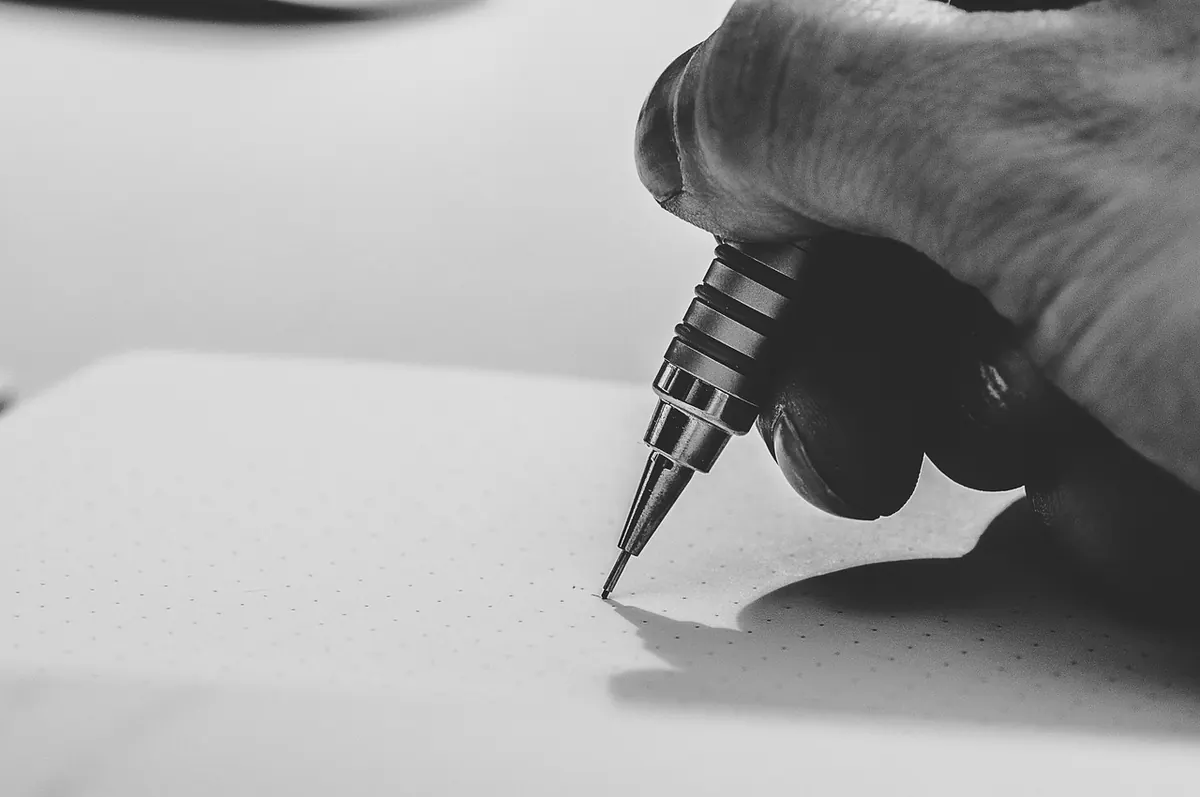
Hold the pen as you would to sign your name: resting on the side of the middle finger, index on top, thumb opposite, tip pointing down and slightly forward. For pen beat, adjust two things. Close the fingers a fraction more than you would for handwriting, and let the back end sit against the base of your thumb rather than resting in the web.
This is the grip for fingertip taps, quiet practice and fine detail. The tip makes a crisp tick; a small flick of the index finger adds a ghost note underneath it. Its weaknesses are volume and stamina. Because the wrist barely rotates, hitting harder forces you to squeeze, and squeezed hands tire quickly and sound dull.
Use it for control work: a notebook in a lecture, a soft tap on the pad of your thumb, or late-night practice when the rest of the house is asleep.
Grip two: the drumstick grip
Turn the pen around and hold it the way a drummer holds a stick: pinched between the pad of your thumb and the first crease of your index finger, with the other three fingers curled loosely underneath as guides. Roughly a third of the pen should overhang your hand, and that overhang is your striking end.
This grip lets the wrist work. The forearm stays fairly still while the wrist rotates around its own axis — the motion of turning a key in a lock — driving the pen onto the desk, the edge of a book, or a second pen held in your other hand. The sound is louder and fuller, the rebound is more reliable, and you can play far longer without cramping.
Most players settle here for desk-based patterns. If the pen keeps sliding up into your palm, you are pinching too near the tip; move your thumb a centimetre towards the back end and try again.
Grip three: the split grip
The split grip threads the pen between the index and middle fingers, pinched by the thumb against the inside of the middle finger, with the index resting on top. It feels wrong for a few days and then feels like a shortcut.
Its advantage is the double stroke: a small wrist rotation brings the tip down, and the back end follows almost for free, giving two clean notes from one movement. It also frees the rest of the hand to strike like a stick, which is how you get a bass drum or a rim sound out of a bare palm.
Keep the split grip for rudiments you already know — single strokes, doubles, basic four-note patterns. Chasing speed in a new grip before the sound is even is how bad habits set in.
Finger pressure: a dial, not a switch
Pressure is the difference between a click and a thud. Think of a scale from one to ten. At rest you want two or three, just enough to stop the pen falling. At contact, briefly, four to six. Then straight back down.
The increase belongs on the way down, not after the hit. Squeezing after contact damps the sound instead of shaping it. Never squeezing at all leaves the pen rattling between your fingers, and every note lands slightly differently. Two quick checks:
- Tap the desk ten times at a steady pulse and watch your own tension. Pale knuckles, or tendons standing up on the back of your hand, mean you are at eight or nine. Aim for four.
- Let the pen sit in the pinch with almost no pressure, then roll it gently back and forth. If it drops, you are too loose. If it will not move at all, you are far too tight.
A good middle feels almost disinterested. The pen is secure and your hand is doing very little.
Wrist, forearm and where you sit
Keep the wrist neutral with the forearm: not bent back, not curled forward, not angled sideways. Sit square to the desk with your elbow at roughly a right angle and your wrist floating just above the surface rather than resting on it. A forearm flattened onto the desk kills the rotation that powers the drumstick and split grips.
Getting the height right
A desk that is too high bends your wrist upwards, so the pen strikes at an angle and the tone flattens. Too low and you hunch, and the shoulder starts doing the work. A stack of books under a notebook raises your playing surface; a cushion on the chair lowers you. A minute of adjusting saves months of awkward technique.
For soft, fast patterns, keep everything small and close to the body. For loud ones, let the wrist open up and treat the desk as a soundboard rather than something to hit as hard as you can.
Mistakes that flatten the sound
- Death grip. White knuckles and a dull click. Loosen the guides and keep only the pivot firm.
- Pen creeping up the palm. Usually the pinch has slipped towards the tip. Reset the overhang.
- Flapping the wrist up and down. It should rotate, not wave. Turning a key, not hammering a nail.
- Playing from the elbow. Whole-arm strokes make quiet notes impossible. Save the big movement for accents.
- Dead forearm. Resting the arm flat removes the rebound. Let the hand float.
- Changing grip every five minutes. Pick one grip per session and stay with it.
A short routine before you practise
Loose hands, precise fingers. If your forearm aches after ten minutes, you are holding on too hard.
Two minutes of setup is worth more than an hour of unfocused tapping.
- Set the pen so about a third overhangs your hand. Pinch it, then check you can still roll it.
- Drop your shoulders and shake out both hands for ten seconds.
- Tap ten slow notes at a steady pulse. Listen for consistency, not speed.
- Tap ten more at half the volume with the same grip. If the quiet ones sound as clean as the loud ones, your pressure control is working.
- Play one pattern you know well, and stop the moment the sound goes thin. Thinness is your cue to reset the grip, not to push through it.
- If anything hurts — fingers, wrist or forearm — stop and rest. Persistent pain is worth raising with a physiotherapist or your GP rather than playing on through it.
Clean taps come from a hand doing less than it thinks it is. Hold the pen at one point, guide it with the rest, keep the wrist neutral, and let pressure rise and fall around the moment of contact. Speed, patterns and dynamics are all built on top of that.
Photo: StockSnap / Pixabay